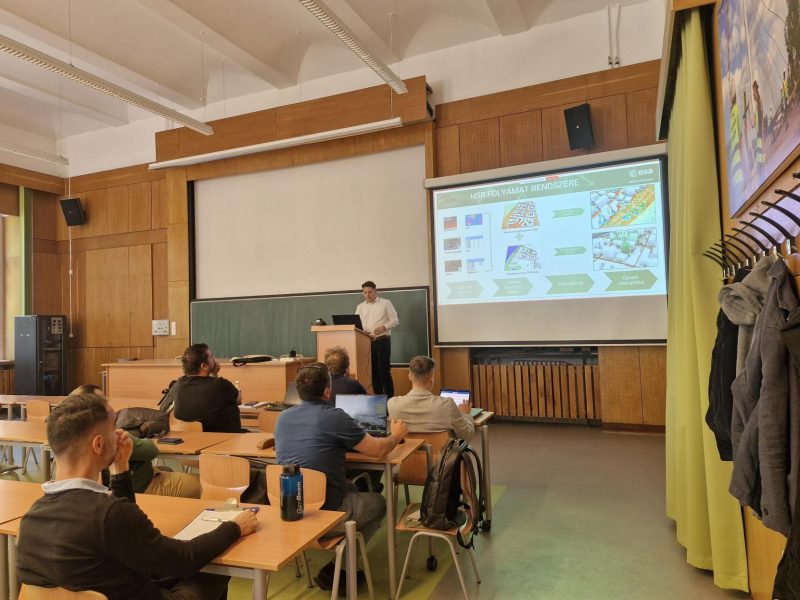
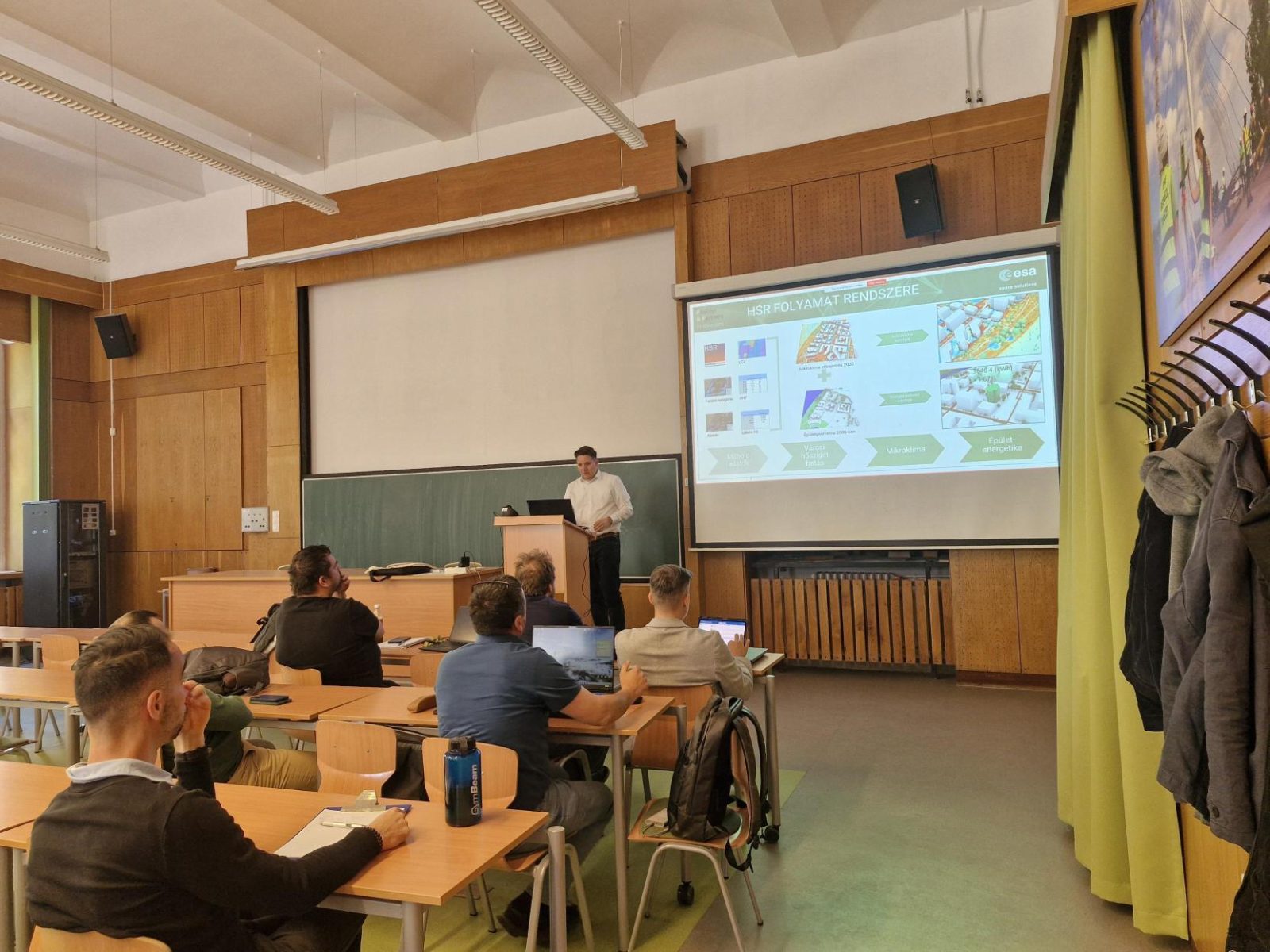
Students of the Budapest University of Technology and Economics' BIM Engineering Programme gained an insight into how data-driven solutions and space technology are shaping the everyday practice of contemporary architecture and construction. Miklós Balaskó, BIM Development Director, and Béla Szivák, Managing Director of Paulinyi & Partners Innovations, delivered a lecture last Friday as part of the programme, presenting our group's latest tools and the company's ongoing collaborations with the European Space Agency (ESA).
Hundreds of scenarios, in three weeks
One of the most prominent topics of the lecture was the Energy Quick Scan (EQS) system, which elevates the strategic questions of the built environment's energy transition to the level of data-driven decision-making. The construction industry is responsible for 36% of the EU's greenhouse gas emissions and 40% of its energy consumption – meaning that retrofitting is not merely an economic issue, but a fundamentally sustainability-driven one.
The EQS operates through a model-based, interactive online interface, through which hundreds of renovation scenarios can be assessed across various cost, energy, and ESG parameters. The system integrates data sources such as Eurostat's construction cost index, the BKI database, and ÖKOBAUDAT LCA data. The result is a detailed digital twin for each building, encompassing the cost, energy impact, value uplift, and ESG classification of renovation options – across four distinct roadmaps: cost-efficient, energy-efficient, low-risk, and net zero.
A new dimension in investment planning
The second system presented, EasyInvest, offers complex, automated decision support for planned building developments. Using genetic algorithms, it is capable of generating thousands of design variants, which are then compared in real-time dashboards across cost, return on investment, and sustainability metrics. Meteorological data, microclimate simulations, pedestrian flow models, and sunlight analyses are all incorporated into the assessments, enabling developers, urban planners, and municipalities to make well-founded decisions at the earliest stages of planning – long before the first shovel breaks ground.
Two chapters of the ESA collaboration
During the lecture, Béla and Miklós also presented the company group's strategic partnership with the European Space Agency. The first joint project, HeatScape Resolve, was launched in 2023 under the "Space for Green Construction" programme. Drawing on data from Sentinel-2 satellites, the system analyses the urban heat island effect and enables the examination of the microclimate of individual plots or entire districts at resolutions of up to 300 metres – including forecasts of changes expected through to 2030.
The most recent chapter is the group's participation in ESA's Space for Construction Monitoring programme, within which the SaSCA (Satellite Scanning and Construction Analytics) service is being developed. Using optical and radar satellite imagery, the system monitors changes taking place on construction sites and compares these against planned schedules – integrated with 4D/5D BIM models. The solution enables the identification of construction phase progress, early detection of deviations, and the generation of automated reports, all without the need for continuous on-site presence.
At the intersection of architecture and technology
The students of the BME BIM Engineering Programme received a comprehensive overview of systems that are no longer merely future promises, but active parts of real development processes. It is of great importance to us that innovation reaches not only professional audiences, but also the next generation of engineers and architects – for it is they who will shape the built environment of tomorrow.